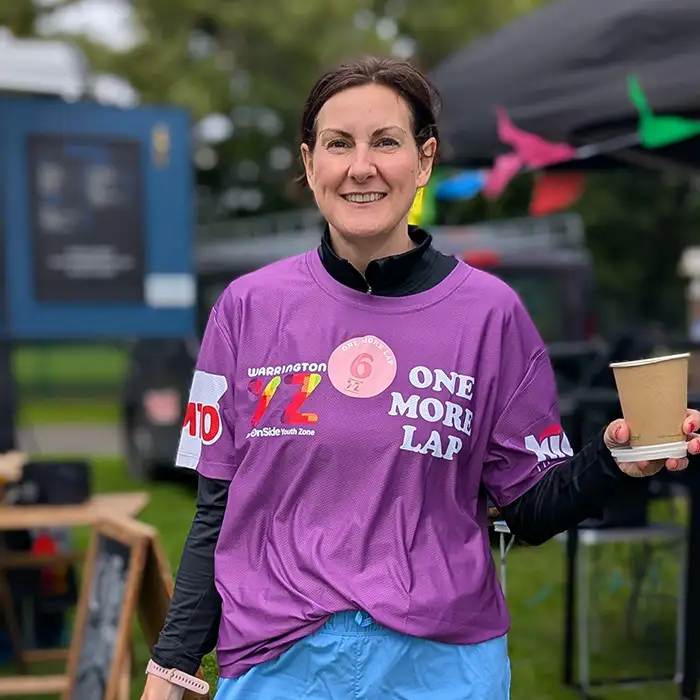
What is an ultramarathon? And why a 12-hour team relay totally counts...
An ultramarathon? That’s for the people who run 100 miles up mountains, right? Well, yeah, it can be.
But it’s also for people who want to spend a day running, laughing and eating snacks with their mates. Here’s your introduction to ultras, how to tackle one, and why One More Lap might just be the friendliest place to start.

What is an ultramarathon?
An ultramarathon is any running event that goes beyond the marathon distance of 26.2 miles.
But ultras are like the jazz of running. It means lots of different things to lots of different people. So, maybe unsurprising that there’s a huge variety of ultras out there. You’ll find 50km races, multi-day 100-mile-plus epics, and time-based events like One More Lap’s 12 hours.
To some folks an ultra’s 100 miles slogging through the mountains in the dark. For others it’s running the furthest they’ve ever gone, with a few mates, a gazebo and the biggest bag of Haribo you’ve ever seen (RIP my teeth).
Both these count. And whatever flavour of ultra you take on, it’s a challenge.
What makes an ultra feel different to a regular race?
In short, time.
A regular race is over in a few hours. An ultra’s a proper day out. It’s less “How fast can I go?” and more “How long can I keep going?” You’ll eat, drink, chat, change your socks AND your t-shirt, and have at least one long hard think about your life choices.
"Because ultrarunning events are so difficult simply to complete, it feels more like a 'We're all in this together' rather than 'Me vs. You'."
Where does One More Lap fit in?
Without wanting to stray too far into “the lady doth protest too much” territory, OML is an ultra.
We’re a 12-hour ultra for teams of runners.
So individually, as you run you short stints across the day, you might run 13-15 miles. And together, your team will cover proper ultra distance. In fact, our 2024 winners did an unbelievable 109 miles between them 🤯
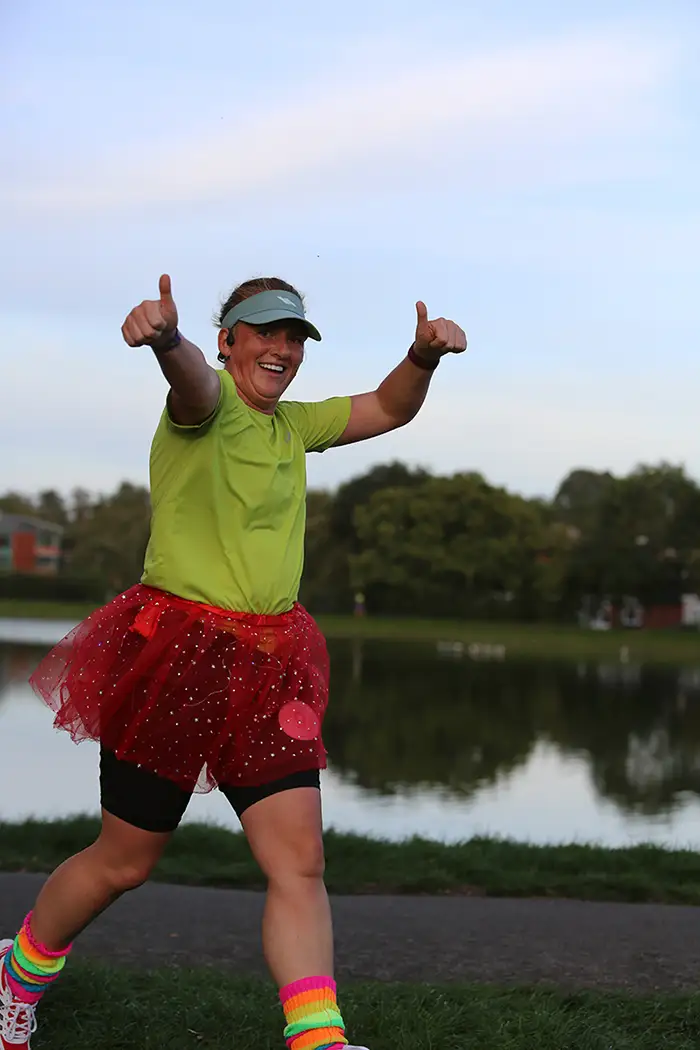
Why do people run an ultramarathon?
The answer is as varied as the people who run them.
Some like the long-term focus it gives their lives. Others want to push themselves and find strength they didn’t know they had. And without wanting to get all reality TV on you, for a lot of people it’s not about the finish line; it’s about the journey.
Here are some of the reasons we hear at OML:
“I’ve always wanted to try an ultra.” OML is a friendly first step: low pressure, short loops, and a camp to relax in.
“My run club talked me into it.” You know, they wanted to be there too.
“Spending a whole day with my friends.” Hard to beat this one.
“I can get quite competitive.” OML is a challenge. But how far you push yourself is up to you.
And tons of people keep coming back to OML. Some are on their third year. Others were brought along by a friend who did it the year before and wouldn’t stop talking about it.
Do you have to be a proper “ultra” runner to be part of OML?
Not at all. OML is an ultra for everyone, whatever your age, running experience or physical ability.
Our mantra at OML is that we don’t break ultra-runners, we make them.
So, the laps are short (between ¼ and 1 mile) and pan flat, meaning you’re never far from camp. You’re running relay style, so there’s plenty of opportunity to recover between your stints. And there’s no pressure to run at anything other than your own pace.
Which means a team of speedy club runners, a team of first-timers and a team of colleagues in matching tutus can all have totally different but equally brilliant days.
Want the full lowdown? How it Works covers teams, captains, the camp and the day itself. About OML tells the story behind the event.
What’s the biggest challenge at OML?
It’s not the distance, and it isn’t the terrain. It’s the camping chair.
Here’s how the day tends to go. The morning is glorious: fresh legs, big smiles, high-fives for everyone. Then 2pm rolls round. You’ve been going for six hours, you feel like you must have completed running. But you’re only halfway.
They say that running isn’t really in your legs; it’s in your head. This is OML between 2pm and 6pm. Runners tell us they massively underestimate this stretch. Your legs would like a word. The camping chair is calling your name. The ice cream queue is looking insanely inviting.
This is where you have dig into your mental reserves, and where your team spirit works its magic.

Does running as a team make it easier?
Different, rather than easier.
You’re not alone out there, which helps. But you’re also accountable to your mates, which is an excellent motivator. Nothing gets you back on the laps like a tired teammate waiting to hand over the slap band.
What surprises people?
How good the atmosphere gets when everyone’s tired. As the day goes on and teams hit the last leg, the whole village rallies. Supporters, volunteers and teams from other gazebos all end up cheering whoever’s out on the course.
How to beat the slump
Ultras are as much a battle of the mind as the body, and One More Lap is no exception. So train your mind too:
Run the stint you’re in – Stay focused on the immediate challenge rather than getting overwhelmed by what’s still to come.
Visualise success – “I’ve finished my stint and I’m recovering in my chair.”
Use positive self-talk – “I’ve got one more lap in my legs.”
Break it into chunks – “Let’s just get to the handover.”
Lean on your team – That’s what they’re for.
How do you pace yourself?
The general advice for any ultra is to start at a pace that feels easy: easy on your legs, and easy enough that you can keep your breathing under control.
At One More Lap, there’s a twist. Don’t just pace your running. Pace your time in camp.
How your team splits the running is entirely up to you. Share it evenly, let your team’s superstar do the lion’s share, or swap on every single lap. Most teams plan around the gaps between stints rather than the stints themselves. Here’s one common set-up: a team of six, each running 20 minutes at a time.
That means every runner gets 100 minutes in camp before they’re next up. Time to eat, stretch, chat, nap and cheer. On that rota, you’d each run for roughly two hours across the whole 12 and spend the rest of the day being a very enthusiastic gazebo person.
You can also take a break whenever you like. Only one runner can be on the course at once, but there doesn’t always have to be someone on it. Have a break, have a Kit Kat, and go again when you’re ready.
What does “going out too hard” look like?
It looks like someone smashing their first stint at personal-best pace, high-fiving everyone, and then discovering that the evening has other plans. Runners who go out too hard can pay the price late in the day.
The good news is you’ve got plenty of time in camp to recover. There’s a free massage on offer for tired legs, and an ice cream as a moral booster (you only get one though, so use it wisely).
Quick pacing tips
💡 Start easier than you think you need to.
💡 Stay at that easy pace.
💡 Use your camp time wisely: eat and drink early, not only when you’re hungry.
💡 Plan for 2pm–6pm. Agree in advance how your team will support each other.
💡 Swap whenever you like. Nobody’s keeping score of how long you stayed out.
How do you train for an ultramarathon?
Here’s the good news: training for One More Lap is a lot less intense than training for a solo ultra. You’re running in short stints with plenty of rest in between. And if you can already run 5-10kms, you’ve got a One More Lap in you. But the stop/start nature of running OML makes later stints tricky.
Obvs, training plan will vary from runner to runner, and depends on how your team splits the running, but here’s a sensible place to start.
The MVP (Minimum Viable Plan)
📝 Get comfortable with your stint length. If you can comfortably run or walk for the length of your stint, you’re most of the way there.
📝 Practise doing it again. The trick to OML is repeating short efforts through a long day. Try a short run, a proper rest, then another short run, a few times.
📝 Get used to being on your feet. One longer walk or jog each week helps your body and brain cope with a long day.
📝 Practise your fuelling. Test snacks and drinks before the day (see below).
📝 Rehearse the mental bit. See the section on the 2pm–6pm slump.
How much you need depends on how your team plans to split the running. Fewer, longer stints mean more training. Lots of short stints are gentler on your legs.
Want to go further? The full ultra toolkit
If you’re thinking about taking on more laps, or building towards a bigger ultra afterwards, here’s the longer version.
🟢 Build a solid base – Run at a comfortable pace and increase your weekly mileage by no more than 10% each week. Include one longer run a week to get used to long periods on your feet.
🟢 Be consistent – Once you have a plan, stick to it. Don’t binge the miles one week and do nothing the next; it’s a sure-fire way to pick up an injury.
🟢 Mix it up – Add strength and mobility work. Stronger muscles and joints help you keep good form and avoid injuries.
🟢 Put your feet up – Rest days matter. Your body needs time to adapt to training.
🟢 Taper – In the weeks before the event, gradually reduce your training to rest and recover while keeping your fitness. Trust your training and resist the urge to squeeze in a last-minute workout.
🟢 Listen to your body – Adjust your training when you need to, and celebrate your progress along the way.
Fuel and kit ~ What to bring
Fuelling and hydration
These are just fancy words for eating and drinking. And as mad as it sounds to a non-runner, it’s worth practising both before the big day. Because endurance challenges are really eating challenges.
So, try different gels, electrolyte drinks and regular food to see what you like, what your stomach can handle and what you can still face after hours of running.
If your ambition is to “not feel like death at about 4pm” carbs are what you want.
Making OML the perfect excuse to eat a Homer’s worth of donuts. Alternatively, lots of ultrarunners love salted new potatoes washed down with pickle juice. Mmm… donuts.
There will be water for you in camp, and we’ll have other drink options on sale too, but you should bring whatever drinks you think you’ll need to get through the day.
Your essential kit list
✅ Shoes you’ve already worn in – Not box-fresh ones.
✅ Spare socks and a blister kit – Your feet will thank you.
✅ Layers and spare clothes – We’ve had rain and we’ve had sunburn. Runners also tell us there are outfit changes galore, especially when forfeits are involved.
✅ Sun cream and a hat, and something waterproof just in case.
✅ Your team’s gazebo and chairs, and snacks for the whole team. Make your corner of camp your “happy place”.
✅ A flask – A hot drink after a wet stint is a very good thing.
✅ A head torch for your last runner – The event finishes at 8pm and the sun sets just before 7:30.
✅ Fancy dress – Optional but, you know, strongly encouraged.

Are ultramarathons safe?
You’re about to spend 12 hours running, so let’s be straight: it’s tiring. That’s sort of the point. But One More Lap is designed to be much kinder than a typical ultra.
The loop is short – so you’re never far from camp or from help.
You’re one of a team – so you’re not out there for long, and you swap whenever you like.
Handovers happen next to event HQ – as you come down the start/finish funnel. That’s how the HQ team know you’re safe, well and back in camp.
Marshals are on the course.
First Aid is on site – and they’re very visible on the course and in camp.
There are free massages in camp to help tired legs recover.
What if I’m struggling on the day?
Tell your teammates and swap out. That’s what the format is for. If you need help, find the nearest marshal or first aider.
Is it too tough for me?
OML is challenging but it’s also super-friendly and zero-pressure. You can walk, you can rest, you can swap, and there’s a whole camp of people cheering you on. So, if it gets too tough, take some time off your feet, grab some food, and enjoy some music. It’s amazing how energising that can be.
What’s the One More Lap community like?
Just the best.
Runners tell us how much they love the atmosphere, the volunteers and the camaraderie.
And our camp is a magical place you just have to experience.
A relaxed, friendly, zero-pressure, community-powered, super-fun place. All day long it’s filled with gloriously decorated gazebos, flags and banners blowing in the breeze, the sizzle of food cooking on grills, the beat of live music & the buzz of teams and their supporters.

Plus, it’s filler with the loveliest people. After all, we’re all there for a good cause – raising money for an ace local charity.
Our four team prizes – Most Laps, Best Dressed Gazebo, Spirit of One More Lap and Most Money Raised – mean there are loads of ways to join in the OML fun.
And there’s a free ice cream, from an actual ice cream van, for every runner (We’re not saying it’s the main reason to sign up. But we’re not saying it not.)
All in it makes OML one of the friendliest ways into the ultra world. If you’d never normally consider an ultra, this might be the one.
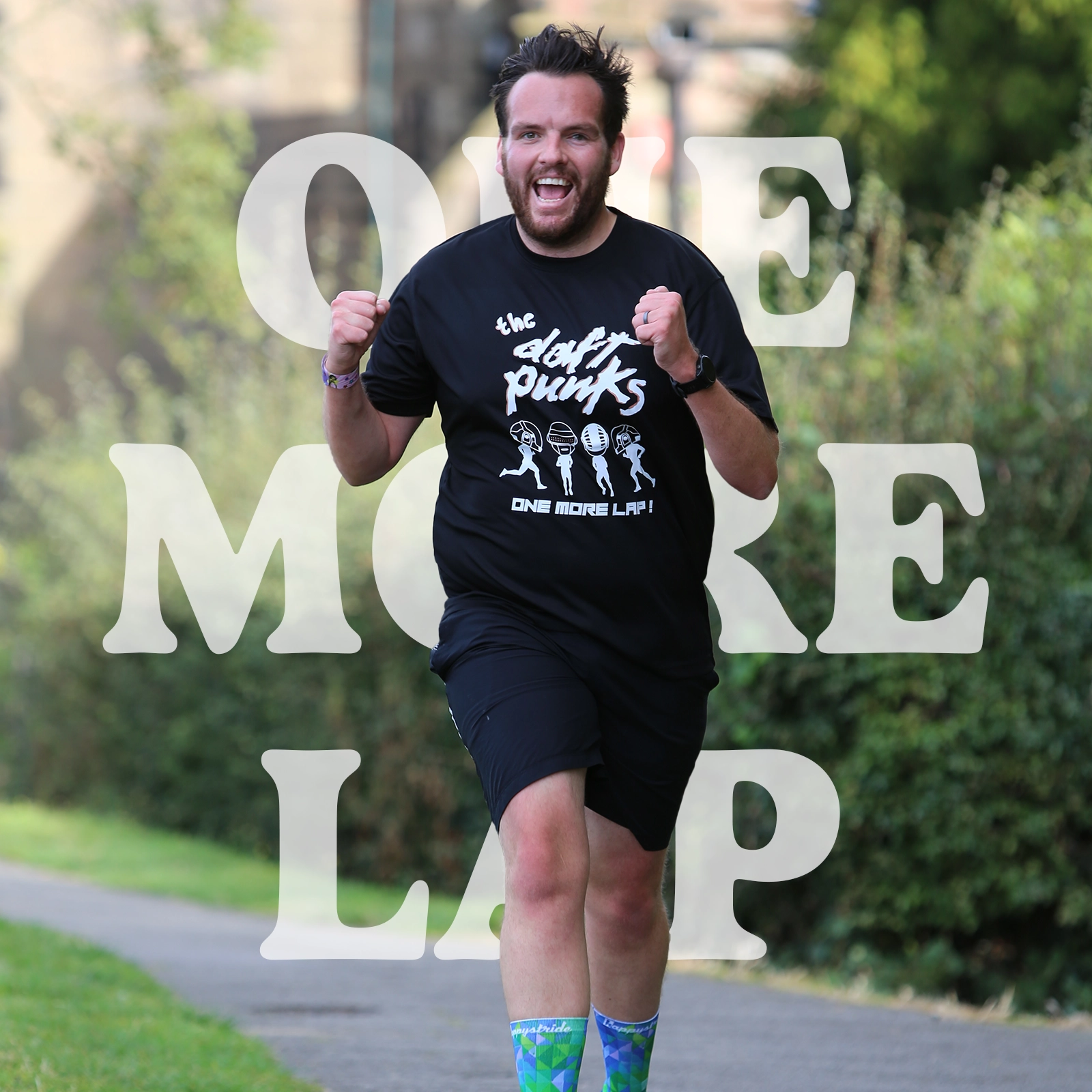
You had me at "Free Ice Cream"
Ready for One More Lap?
Whether you're a lifelong runner or your last lap was at primary school sports day, there's a place for you at One More Lap.
And now you've read the guide, you've seen the FAQs, you know about the ice cream. All that's left is to gather your team and join the fun.
Or still got questions? Get in touch!